


By Jackson Godwin. Cybersecurity Analyst & Penetration Tester.

Your phone rings at 8:45 PM.
The caller ID displays the name of your bank.
You answer.
“Good evening, Mr. Jackson. This is David from the Fraud Department. We’ve detected suspicious transactions on your account. To stop the hackers, please confirm the six-digit verification code we just sent to your phone.”
The caller knows your name.
He knows your bank.
He speaks professionally.
Everything sounds legitimate.
A few minutes later, your mobile banking account has been emptied.
Now imagine another situation.
It’s midnight.
Your phone rings again.
This time, you hear your younger brother crying.
“Please help me… I’ve been kidnapped. They want ₦500,000 immediately. Don’t call anyone.”
His voice sounds real.
It sounds exactly like him.
But it isn’t.
It is an AI-generated voice clone created by cybercriminals.
This isn’t science fiction. With advances in artificial intelligence, criminals are increasingly using AI-generated voices to deceive victims into sending money or revealing sensitive information. Learning how these scams work is one of the best ways to protect yourself.
What Is a Deepfake Voice Scam?
A deepfake voice scam is a form of voice phishing (vishing) where attackers use AI to imitate someone’s voice.
The goal is to make the victim believe they are speaking with a trusted person.
Common targets include:
- Bank officials
- Family members
- Friends
- Company executives
- Government officials
- Customer service representatives
Unlike traditional scam calls, these attacks rely on realistic AI-generated speech rather than poor impersonations.
How Criminals Clone a Voice
Many people unknowingly publish recordings of their voices online through:
- TikTok videos
- Instagram Reels
- Facebook videos
- YouTube channels
- Podcasts
- WhatsApp voice notes
Using publicly available recordings—or audio obtained through fraud—AI tools can generate speech that closely resembles the original speaker.
The technology is improving rapidly, which is why it’s important to verify unexpected requests rather than relying on a familiar voice alone.
A Realistic Scam Scenario
Imagine receiving a call from someone claiming to work for your bank.
The caller says:
“We’ve stopped hackers from stealing your money. We just need to verify your identity.”
They ask you to:
- Confirm your password
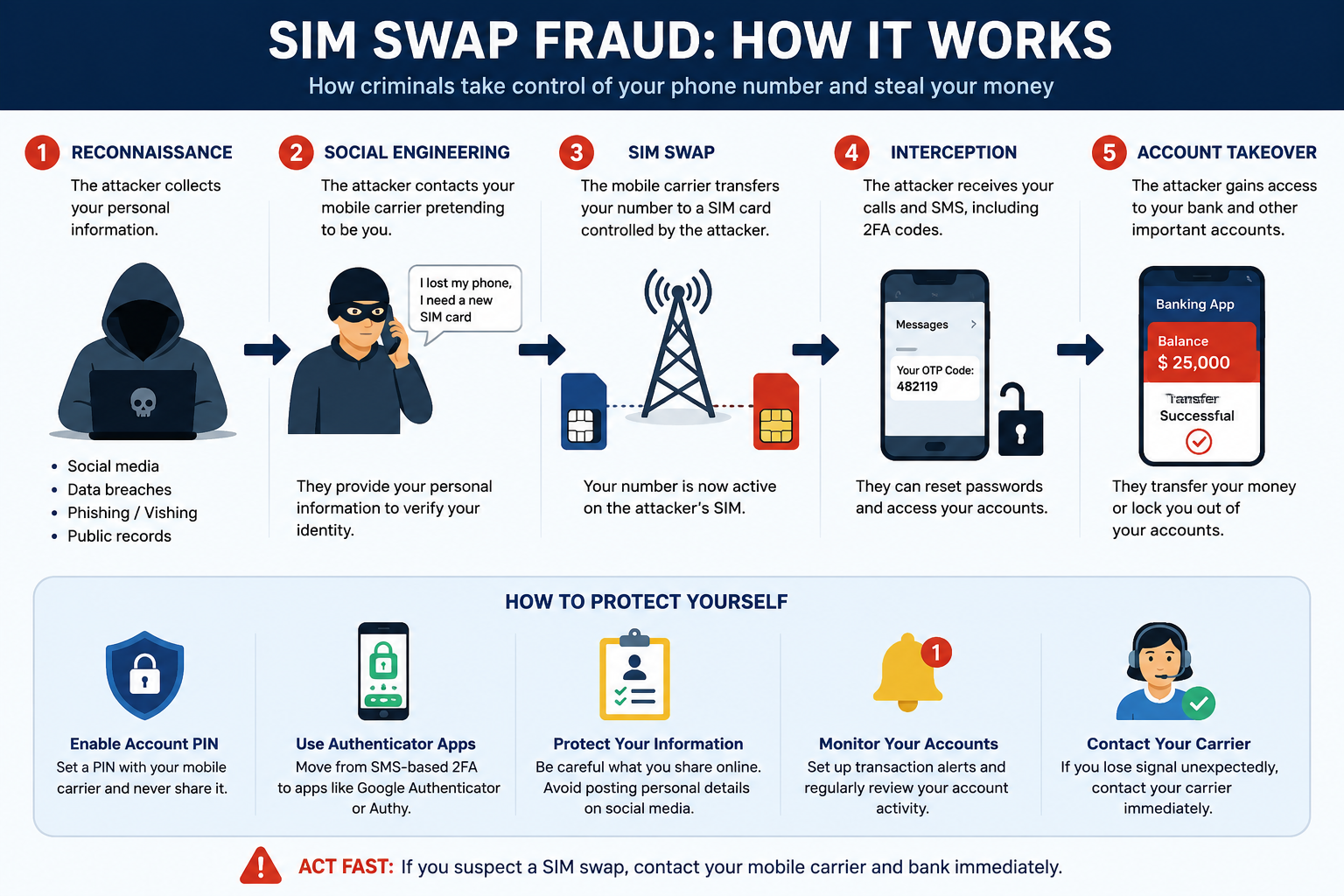
- Read your One-Time Password (OTP)
- Approve a banking notification
- Install a “security application”
Believing you’re protecting your account, you cooperate.
In reality, the scammer is using the information to access your account.
This type of fraud succeeds because it creates urgency and exploits trust.
Why These Scams Work
Deepfake voice scams rely more on psychology than technology.
Criminals create:
- Fear
- Panic
- Urgency
- Trust
- Authority
When people think a loved one is in danger or their bank account is under attack, they often react before verifying the information.
Warning Signs
Be cautious if the caller:
- Demands immediate action.
- Asks for passwords or OTPs.
- Pressures you not to hang up.
- Says “Don’t tell anyone.”
- Requests payment through cryptocurrency, gift cards, or unfamiliar accounts.
- Becomes angry when you ask questions.
A legitimate bank will never ask for your password, PIN, or OTP over the phone.
How to Protect Yourself
Verify the Caller
If someone claims to be from your bank:
- End the call politely.
- Call your bank back using the official number printed on your debit card or listed on its official website.
Create a Family Safe Word
Choose a secret word or phrase known only to close family members.
If you receive an emergency call, ask for the safe word before taking any action.
Don’t Trust Caller ID Alone
Phone numbers can sometimes be spoofed to appear as if they belong to trusted organizations.
Protect Your Voice
Avoid sharing unnecessary voice recordings publicly, especially if they include personal details that could help criminals impersonate you.
Slow Down
Scammers want you to panic.
Take a few moments to think, verify, and confirm before acting.
What Banks Are Doing
Financial institutions are responding to AI-enabled fraud by:
- Using behavioral analytics to detect suspicious activity.
- Monitoring unusual transactions.
- Strengthening identity verification processes.
- Combining multiple authentication methods instead of relying only on voice.
- Educating customers about social engineering attacks.
These measures make fraud more difficult, but customer awareness remains a critical layer of defense.
If You Receive a Suspicious Call
If you think the call is fraudulent:
- Hang up immediately.
- Contact your bank using its official phone number.
- Verify the situation with your family member through another trusted method.
- Change your banking password if you shared any information.
- Report the incident to your bank.
Quick action can help prevent further losses.
Best Practices
- Never share your banking password over the phone.
- Never reveal an OTP to anyone.
- Be skeptical of urgent requests.
- Verify unexpected calls independently.
- Keep banking apps and devices updated.
- Enable multi-factor authentication where available.
Final Thoughts
Artificial intelligence has transformed many industries, but it has also given cybercriminals new tools for deception.
A familiar voice is no longer enough to prove someone’s identity.
Whether the caller claims to be your bank, a government official, or even a close relative, take a moment to verify before sharing information or sending money.
In cybersecurity, a few minutes of verification can prevent a lifetime of regret.
Frequently Asked Questions (FAQ)
Can AI really clone someone’s voice?
Yes. Modern AI systems can generate speech that closely resembles a person’s voice when trained on sufficient audio. The quality varies, but it can be convincing enough to support social engineering scams.
Can caller ID be trusted?
Not always. Some scams involve caller ID spoofing, making it appear that the call comes from a trusted organization.
What should I do if a “bank employee” asks for my OTP?
Do not share it. End the call and contact your bank using its official customer service number.
About the Author
Jackson Godwin is a Cybersecurity Consultant specializing in Vulnerability Assessment and Penetration Testing (VAPT), Governance, Risk and Compliance (GRC), Information Security, Enterprise Security Assessments, and Banking Cybersecurity. Through JacksonTechnology.com.ng, he publishes practical cybersecurity tutorials, fraud awareness guides, and compliance resources to help individuals, businesses, and financial institutions strengthen their defenses against evolving cyber threats.