


By Jackson Godwin. Cybersecurity Analyst & Penetration Tester.
What the Criminals Were Really After
Tunde couldn’t stop thinking about what had happened.
He had always believed hackers needed expensive software or advanced technical skills to steal information.
David smiled.
“Most successful cyberattacks don’t begin by attacking computers. They begin by attacking people.”
That sentence stayed with Tunde.
The attackers didn’t need to break into his phone.
They simply needed him to trust the wrong Wi-Fi network.
Once he connected, they waited.
They watched.
They looked for opportunities.
How Public Wi-Fi Attacks Can Work
When people hear about public Wi-Fi attacks, they often imagine a hacker instantly stealing every password on a phone.
In reality, the situation is more nuanced.
Modern smartphones and websites include security protections that make many attacks much more difficult than they once were.
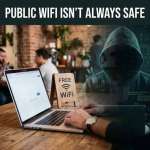
However, public Wi-Fi can still become risky under certain conditions, especially when criminals create fake hotspots or trick users into giving away information.
Some of the most common techniques include:
- Fake Wi-Fi hotspots (sometimes called “evil twin” networks)
- Phishing pages that imitate legitimate login portals
- Fake software update prompts
- Fraudulent payment pages
- Browser warning bypass tricks
Instead of attacking the device directly, criminals often try to manipulate the user into revealing sensitive information.
The Fake Login Page
David explained another common trick.
Some fake public Wi-Fi networks display what appears to be a normal login page before allowing internet access.
The page may ask for:
- Your email address
- Your phone number
- Your social media account
- Your password
Many people assume this is part of the normal Wi-Fi registration process.
Sometimes it is.
Sometimes it isn’t.
Cybercriminals know that people are less cautious when they are travelling.
They’re tired.
They’re in a hurry.
They’re distracted.
That makes them easier targets.
Modern Websites Are Safer Than Before
The good news is that today’s internet is much more secure than it was ten years ago.
Most reputable websites now use HTTPS encryption, which helps protect information exchanged between your browser and the website.
You can usually recognize this by the padlock icon in your browser’s address bar.
HTTPS significantly reduces the risk of someone reading your traffic on the network.
However, encryption cannot protect you if:
- You willingly enter your password into a fake website.
- You ignore browser security warnings.
- You download malicious software.
- You trust a fraudulent login page.
In other words…
Technology can protect the connection.
It cannot always protect the decision.
The Coffee Shop Experiment
David shared an interesting story from a cybersecurity awareness workshop.
An instructor created two Wi-Fi networks.
One was the real café Wi-Fi.
The other had almost the same name.
The fake network was stronger because it was positioned closer to the audience.
Without being told which was real, nearly half the participants connected to the fake network first.
Not because they lacked intelligence.
Because they trusted what appeared familiar.
That is exactly how many real-world attacks begin.
Five Minutes Can Change Everything
Imagine this situation.
You connect to free Wi-Fi.
You check your email.
You log into your shopping account.
You browse social media.
Everything feels normal.
Meanwhile, an attacker may be trying to redirect you to fake websites or capture credentials through phishing pages.
Again, the greatest danger often comes from deception—not from magical hacking.
The Biggest Myth About Public Wi-Fi
Many people believe:
“Public Wi-Fi is always dangerous.”
That isn’t entirely true.
Many public networks provided by airports, hotels, universities, and reputable businesses are professionally managed and reasonably secure.
The real issue is this:
You often cannot tell whether the network you’re connecting to is genuine without verifying it.
That is why cybersecurity professionals recommend caution instead of fear.
Safe Browsing Habits Everyone Should Learn
After hearing David’s explanation, Tunde decided to change the way he used public Wi-Fi forever.
Here are the habits he adopted.
1. Verify the Network Name
Before connecting, ask a staff member for the official Wi-Fi name.
Never assume the strongest signal is the correct one.
2. Avoid Sensitive Activities
If possible, avoid logging into:
- Online banking
- Investment platforms
- Government portals
- Business administration systems
while using public Wi-Fi.
If you must access these services, consider using your mobile data or another trusted connection.
3. Check for HTTPS
Before entering passwords or payment information, confirm that the website uses HTTPS and that the address matches the legitimate domain.
A padlock alone doesn’t guarantee a site is genuine, so always read the web address carefully.
4. Keep Your Software Updated
Phone manufacturers regularly release security updates.
Installing them promptly helps protect your device against known vulnerabilities.
5. Turn Off Automatic Wi-Fi Connections
Many smartphones automatically reconnect to networks you’ve used before.
Disable automatic joining for public hotspots you no longer use.
This reduces the chance of connecting to a rogue network with a similar name.
6. Use Mobile Data When Appropriate
If you’re making important financial transactions, your cellular connection may be a safer option than an unknown public hotspot.
A Small Habit That Makes a Big Difference
Today, whenever Tunde enters an airport or café, he no longer asks:
“Is there free Wi-Fi?”
Instead, he asks:
“What is the official Wi-Fi network?”
That one question dramatically reduces the chance of connecting to a fake hotspot.
Sometimes, cybersecurity is not about expensive software.
Sometimes…
It begins with asking the right question.
👉 End of Part 2
In Part 3, you’ll learn what to do if you’ve already connected to a suspicious Wi-Fi network, whether a VPN helps, common myths about public Wi-Fi, a practical cybersecurity checklist for travelers, FAQs for SEO, the conclusion, and the About the Author section.