Testing Your WAF Against Advanced Injection Vectors: A Practical Audit Guide
July 11, 2026
Com 0
By Jackson Godwin. Cybersecurity Analyst & Penetration Testing
Educational Purpose Only: This tutorial is intended for authorized security testing, penetration testing, and educational purposes only. The techniques discussed here should only be applied to systems you own or have explicit written permission to test. Unauthorized exploitation of XSS vulnerabilities is illegal. Always follow responsible disclosure practices.
Hello folks! 🙂 In this session, we’ll cover various evasion techniques used to bypass Web Application Firewalls (WAF) during XSS exploitation. This knowledge is vital for penetration testers and security researchers who need to assess the true effectiveness of WAF protections in controlled, authorized environments.
Let’s dive in! 🙂
Introduction
Web Application Firewalls (WAFs) are a critical layer of defense for modern web applications, designed to detect and block a wide range of attacks – including Cross-Site Scripting (XSS). However, no security measure is foolproof. Skilled attackers continuously develop new evasion techniques to bypass WAF filters and execute malicious payloads. In this article, we’ll examine some of the most common WAF bypass methods used during XSS attacks. Understanding these techniques is essential for security professionals looking to strengthen their defenses and fine-tune their WAF configurations.
Understanding XSS and WAFs
Cross-Site Scripting (XSS) is a common injection attack in which malicious scripts are embedded into trusted web content and delivered to unsuspecting users. Once executed in the user’s browser, these scripts can perform a variety of harmful actions – including stealing sensitive data, hijacking user sessions, and performing unauthorized actions on behalf of the victim. This makes XSS one of the most critical security risks facing web applications today.
WAFs are designed to filter and monitor HTTP requests, blocking any malicious attempts based on predefined rules or learning algorithms. However, WAFs are not foolproof, and attackers constantly develop new methods to evade them
Common WAF Bypass Techniques
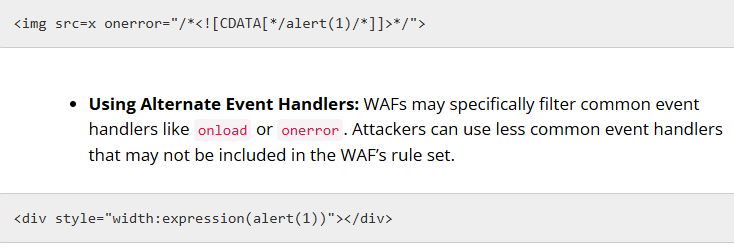
Obfuscation: Attackers often obfuscate their XSS payloads to bypass WAF detection. Techniques like encoding the payload in different formats (e.g., HTML entities, Base64) or breaking up the script with comments or unnecessary characters can trick the WAF into allowing the payload through.
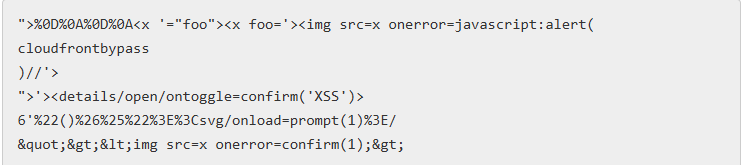
Polyglot Payloads: A polyglot XSS payload can be interpreted in multiple contexts, increasing its chances of bypassing a WAF. These payloads are designed to execute regardless of whether they are processed as HTML, JavaScript, or another scripting language
Payload Splitting: Splitting the payload into multiple parts can sometimes evade detection, as WAFs may not correctly reassemble the script in its entirety.
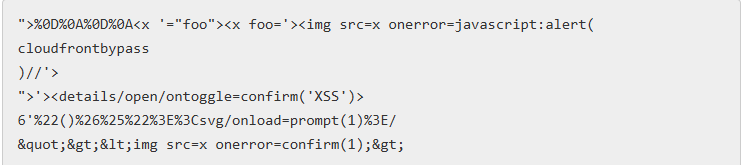
Cloudfront XSS payloads
WordFence XSS payloads
Best Practices for Defenders While understanding how attackers bypass WAFs is crucial, it’s equally important for defenders to continuously update WAF rules, employ multiple layers of security, and conduct regular security assessments.
Regular Updates: Keep WAF signatures and rules up-to-date to cover new and emerging threats.
Defense-in-Depth: Utilize a combination of security mechanisms (e.g., input validation, Content Security Policy) alongside the WAF for better protection.
Security Testing: Regularly perform penetration testing and security assessments to identify and patch any vulnerabilities that could be exploited.
Conclusion: Bypassing a WAF with XSS payloads requires creativity and a deep understanding of both the WAF’s limitations and the web application itself. While WAFs provide a strong line of defense, they should not be solely relied upon. A layered security approach combined with continuous monitoring and testing is essential to defend against these sophisticated attacks.
Disclaimer: The techniques discussed in this article are standard penetration testing methods used to evaluate the security of web applications. They should only be performed in controlled environments or with explicit client authorization. Unauthorized testing is considered illegal under laws such as the Computer Fraud and Abuse Act (CFAA) and similar international regulations. Use this knowledge responsibly.
Jackson Godwin is a Cybersecurity Consultant specializing in Vulnerability Assessment and Penetration Testing (VAPT), Governance, Risk and Compliance (GRC), Information Security, and Enterprise Security Assessments. Through JacksonTechnology.com.ng, he shares practical cybersecurity tutorials, compliance guides, and career advice to help aspiring professionals and organizations strengthen their cybersecurity capabilities.