
by Jackson Goodwin, Cybersecurity Analyst & Penetration Tester
What Is Governance, Risk, and Compliance?
Governance, Risk, and Compliance — universally abbreviated as GRC — is an integrated framework that aligns an organisation's cybersecurity strategy with its business objectives, regulatory obligations, and risk appetite. Far from being a bureaucratic formality, a well-implemented GRC programme is the operational backbone that enables organisations to make confident decisions about risk, demonstrate accountability to regulators, and build the kind of institutional trust that enterprise customers demand before signing contracts.
First formalised as a discipline in the mid-2000s by OCEG (Open Compliance and Ethics Group), GRC has evolved dramatically in response to an exploding regulatory landscape, increasingly sophisticated cyber threats, and the complex interdependencies created by cloud infrastructure and third-party supply chains. Today, organisations in the United States, the United Kingdom, Canada, and Australia face some of the most demanding GRC environments in the world.
The Three Pillars Explained
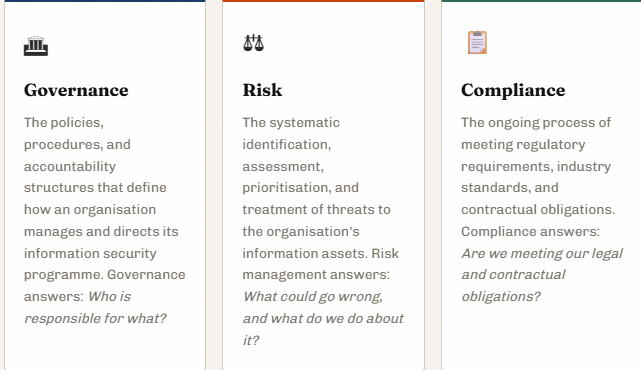
GRC is not a single technology or process — it is the integration of three distinct but interdependent disciplines. Understanding each pillar in depth is the prerequisite to building a programme that delivers real security outcomes rather than compliance theatre.
Governance — Setting the Strategic Direction
Effective governance begins at the board level. In mature organisations, cybersecurity governance is not delegated entirely to the CISO — it is a board-level responsibility that informs investment decisions, risk appetite statements, and strategic planning. This means establishing a clear Information Security Policy, defining roles through a RACI matrix, creating an Information Security Management System (ISMS), and ensuring that security objectives are embedded in the organisation's broader business strategy.
In the UK, the UK Corporate Governance Code and FCA guidance explicitly require boards to understand and oversee cyber risk. In the US, the SEC's cybersecurity disclosure rules (effective December 2023) mandate that public companies disclose material cybersecurity incidents and annual risk management practices to shareholders — elevating governance from an internal discipline to a public accountability obligation.
Risk Management — From Identification to Treatment
Risk management within a GRC context follows a structured lifecycle: identify, assess, prioritise, treat, and monitor. The output of this process is typically a risk register — a living document that catalogues every identified risk, its likelihood and impact scores, its assigned owner, and its treatment status.
Risk treatment options follow four strategies commonly abbreviated as the 4 Ts: Tolerate (accept the risk), Treat (implement controls to reduce it), Transfer (insure against it via cyber liability coverage), and Terminate (exit the activity that creates the risk entirely). A well-managed risk programme ensures every material risk has a documented treatment decision made by an accountable owner — not a committee of people who collectively own nothing.
Compliance — Meeting the Regulatory Landscape
For enterprises operating across Tier 1 markets, the compliance obligation is multi-layered and jurisdiction-specific. A US healthcare organisation processing payment card data, for example, may simultaneously face HIPAA, PCI-DSS, SOC 2, and state-level privacy law requirements. A UK financial services firm may carry FCA, ICO, and ISO 27001 obligations concurrently. The compliance function is responsible for mapping these requirements, identifying overlaps, closing gaps, and maintaining the audit evidence that demonstrates ongoing adherence.
Key GRC Frameworks by Region
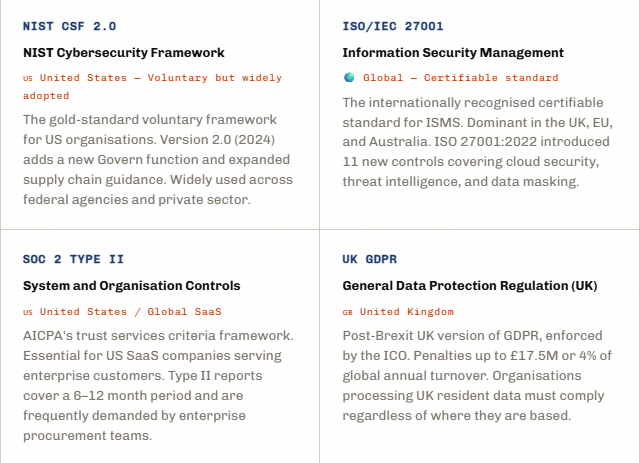
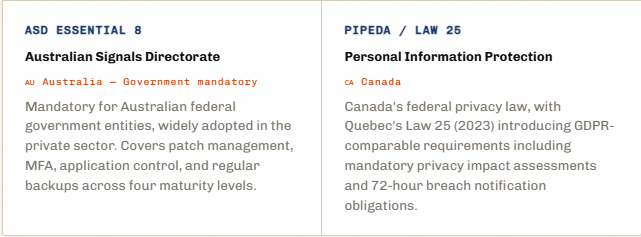
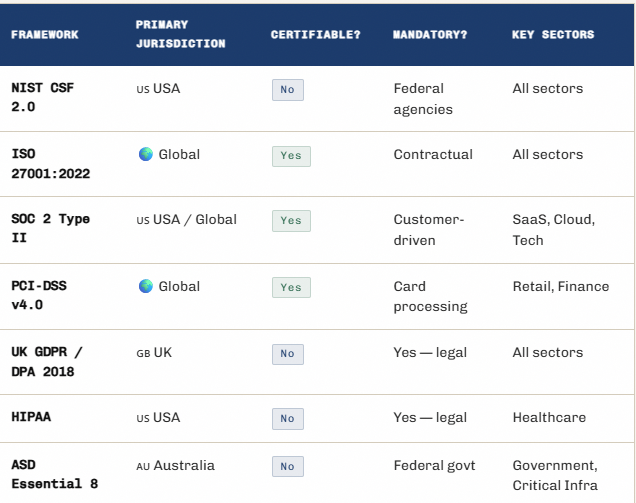
No single GRC framework applies universally — the right framework depends on your industry, jurisdiction, and the type of data you process. Here are the most important frameworks relevant to Tier 1 markets.
Why GRC Matters in 2024
Compliance is the floor, not the ceiling. The organisations that treat GRC as a minimum obligation are the ones that discover — too late — that the floor has collapsed.— Jackson Goodwin, Cybersecurity Analyst
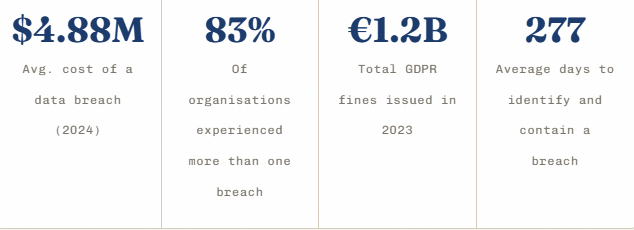
The business case for robust GRC investment has never been stronger — or more data-driven. Beyond the headline breach costs, the compounding consequences of poor GRC practice include regulatory fines, loss of enterprise contracts requiring compliance certifications, directors' personal liability under frameworks like the UK's Senior Managers and Certification Regime (SMCR), and the reputational damage that customer-facing organisations rarely recover from fully.
In 2023, the UK's Information Commissioner's Office issued over £9.5 million in fines for data protection failures. The US FTC imposed $3 billion in civil penalties across data and privacy enforcement actions. Australia's Office of the Australian Information Commissioner (OAIC) significantly increased enforcement activity following the Optus and Medibank breaches — the two largest in Australian history — which collectively exposed the personal data of over 12 million Australians.
⚡ 2024 Regulatory Shift
The SEC's new cybersecurity disclosure rules, effective from December 2023, require US public companies to disclose material cybersecurity incidents within 4 business days of determining materiality — and to provide annual disclosures on cybersecurity risk management, strategy, and governance. Non-compliance carries SEC enforcement risk on top of the underlying breach consequences.
05
Building a GRC Programme That Actually Works
Most GRC programmes fail not because of poor intent, but because they are built backwards — starting with tools or frameworks and working inward, rather than starting with the organisation's actual risk profile and working outward. Here is the sequence that delivers results.
- Define Scope and Business Context
Map the organization's critical assets, data flows, regulatory obligations, and business processes before selecting any framework. A healthcare SaaS company in the US has a fundamentally different GRC scope than a financial services firm in London. - Conduct a Baseline Risk Assessment
Use a recognized methodology — ISO 27005, NIST SP 800-30, or FAIR (Factor Analysis of Information Risk) — to identify and score your current risk landscape. This baseline determines the gap between your current state and your target state, and prioritizes where investment delivers the greatest risk reduction. - Select and Map Your Framework(s)
Choose the frameworks that align with your regulatory obligations and customer requirements. Use a controls crosswalk to identify where frameworks overlap — ISO 27001 and NIST CSF share approximately 85% of their control objectives. Building to the intersection of multiple frameworks simultaneously is far more efficient than sequential compliance projects. - Establish Governance Structures
Formalize the Information Security Management System: appoint a CISO or equivalent, establish a security committee with board representation, define the risk appetite statement, and publish the Information Security Policy. Accountability without a governance structure is an aspiration, not a programme. - Implement Controls and Measure Effectiveness
Deploy the technical and administrative controls your risk assessment identified as priorities. Critically, measure control effectiveness — not just control presence. A patching policy that exists but is 40% compliant is a control that provides 40% of its intended protection. GRC metrics must reflect reality, not aspiration. - Build a Continuous Monitoring Programme
GRC is not a project with an end date — it is a continuous programme. Implement automated monitoring, schedule regular internal audits, conduct annual penetration tests to validate controls, and review the risk register quarterly. The regulatory environment changes; your threat landscape changes; your GRC programme must change with them.
06
GRC Tools & Platforms
At scale, manual GRC management becomes unsustainable. Dedicated GRC platforms centralize risk registers, policy management, audit evidence, and compliance tracking — turning what would otherwise be a sprawling spreadsheet operation into a governed, auditable programme.
- ServiceNow GRC— Enterprise-grade integrated risk and compliance management platform, dominant in large US and UK enterprises. Connects GRC data directly to IT service management workflows.
- OneTrust GRC— Strong privacy compliance focus with GDPR, CCPA, and PIPEDA modules. Widely adopted by organizations with significant data privacy obligations across multiple jurisdictions.
- Vanta— Automated compliance for SOC 2, ISO 27001, and HIPAA. Particularly popular with US SaaS startups and scale-ups seeking their first compliance certification with minimal manual overhead.
- RSA Archer— Mature enterprise GRC platform with deep risk quantification capabilities. Common in US financial services and healthcare organizations with complex risk management requirements.
- LogicGate— Flexible, configurable risk management platform that adapts to custom GRC workflows without heavy IT implementation overhead.
- Drata / Secureframe— Continuous compliance monitoring platforms that automate evidence collection for SOC 2, ISO 27001, PCI-DSS, and HIPAA audits through integrations with cloud infrastructure.
07
Common GRC Mistakes That Undermine Programmes
Years of security consultancy across enterprise environments consistently surface the same failure patterns. Recognizing these mistakes is the first step to avoiding them.
- Treating GRC as a compliance project rather than a risk management programme. Once the audit is passed, the programme goes dormant — until the next audit. Genuine security improvement requires continuous operation, not periodic sprints.
- Siloing GRC from the wider business. When GRC lives exclusively in IT or security, it loses the business context that makes risk assessments accurate and treatment decisions realistic. Risk owners must be business leaders, not just technical staff.
- Selecting frameworks based on prestige rather than fit. ISO 27001 certification is genuinely valuable — but if your primary customers require SOC 2 reports and you're building towards ISO first, you're solving the wrong problem.
- Documenting policies that do not reflect reality. A policy stating that all systems are patched within 14 days, when the actual average is 60, is not a control — it is a liability. Regulators and attackers both exploit the gap between stated policy and operational reality.
- Neglecting third-party and supply chain risk. In 2024, the majority of material data breaches involve a third-party vendor or supply chain component. A GRC programme that doesn't extend vendor risk management to critical suppliers has a structural blind spot that attackers actively target.
Measuring GRC ROI — Making the Business Case
Security leaders in Tier 1 markets increasingly face pressure to quantify the return on GRC investment for CFOs and boards who speak the language of cost and risk, not frameworks and controls. The business case for GRC investment rests on four measurable pillars.
First, breach cost avoidance: IBM's research consistently shows organizations with mature security programmes experience breaches that cost an average of $1.76 million less than those without. Second, regulatory fine avoidance: a single GDPR enforcement action can dwarf the annual cost of an ISO 27001-compliant GRC programme. Third, enterprise contract enablement: SOC 2 Type II and ISO 27001 certifications are increasingly table-stakes requirements for enterprise procurement in Tier 1 markets — the inability to demonstrate compliance is a direct revenue barrier. Fourth, cyber insurance premium reduction: insurers are pricing premiums directly against GRC maturity, with organizations demonstrating a strong GRC posture achieving meaningfully lower premiums.
The ROI on a well-implemented GRC programme is not theoretical — it is quantifiable, auditable, and increasingly demanded by the boards and investors who fund enterprise security programmes. The question is no longer whether to invest in GRC, but how to build a programme that delivers measurable outcomes at the pace a dynamic threat and regulatory environment demands.
Governance, Risk, and Compliance is the strategic layer that makes every other cybersecurity investment coherent. Without it, organizations accumulate security tools without security outcomes, pass audits without achieving resilience, and face regulators with documentation that does not reflect operational reality. With it, security becomes a business enabler — demonstrable to customers, defensible to regulators, and genuinely protective of the assets that matter most.